
TL;DR:
- Automating savings and bills simplifies budgeting by focusing on a single flexible balance instead of detailed expense tracking. This method uses two accounts to handle fixed obligations automatically and keeps the remaining funds for discretionary spending, reducing decision fatigue. Adjust the savings rate if the flexible account empties early, and use system design to promote better financial behavior over time.
You can budget without tracking every purchase by automating your savings and fixed bills first, then spending whatever remains freely. This approach is known in personal finance circles as the "anti-budget" or "no-budget budget," and it replaces daily expense logging with a single, clear spending boundary. The core idea is simple: handle the disciplined part once, automatically, and let the rest take care of itself. Tools like DivvyUpp take this further by giving you a daily "safe-to-spend" number so you always know where you stand without logging a single transaction.
How automation lets you budget without tracking every purchase
The foundation of spending plans without details is a two-account setup. One account handles fixed obligations: rent or mortgage, utilities, insurance, and automated savings transfers. The other account holds what is left, and that balance is the only number you need to watch.
Automating savings and bills removes the daily decision-making that drains most budgets. When money moves to savings and bills before you see it, you cannot accidentally spend it. The anxiety that kills most budgets disappears because the boundary is enforced by the system, not by your willpower.
Here is what a clean two-account structure looks like:
| Account | Purpose | What goes in | What you monitor |
|---|---|---|---|
| Fixed obligations account | Bills and savings | Rent, utilities, insurance, automated savings | Nothing daily |
| Flexible spending account | Everything else | Remaining take-home pay | Balance only |
The flexible spending account is the only number that requires your attention. You do not track groceries, dining, or entertainment separately. You simply watch the balance and spend until it reaches zero or the next pay cycle arrives.
- Automated savings transfer: Moves on payday, before you touch anything.
- Automated bill payments: Scheduled for their due dates from the fixed account.
- Flexible balance: Replenished each pay cycle after obligations are covered.
Pro Tip: Set your automated transfers to fire within 24 hours of your paycheck landing. The longer money sits in a general account, the more likely it gets spent before the transfer runs.
This setup requires roughly 5 minutes per week to maintain. That is a balance check, not a transaction review. The time savings alone make this method worth trying.
Step-by-step guide to setting up a no-tracking spending plan
Getting this system running takes one focused afternoon. After that, it runs itself.
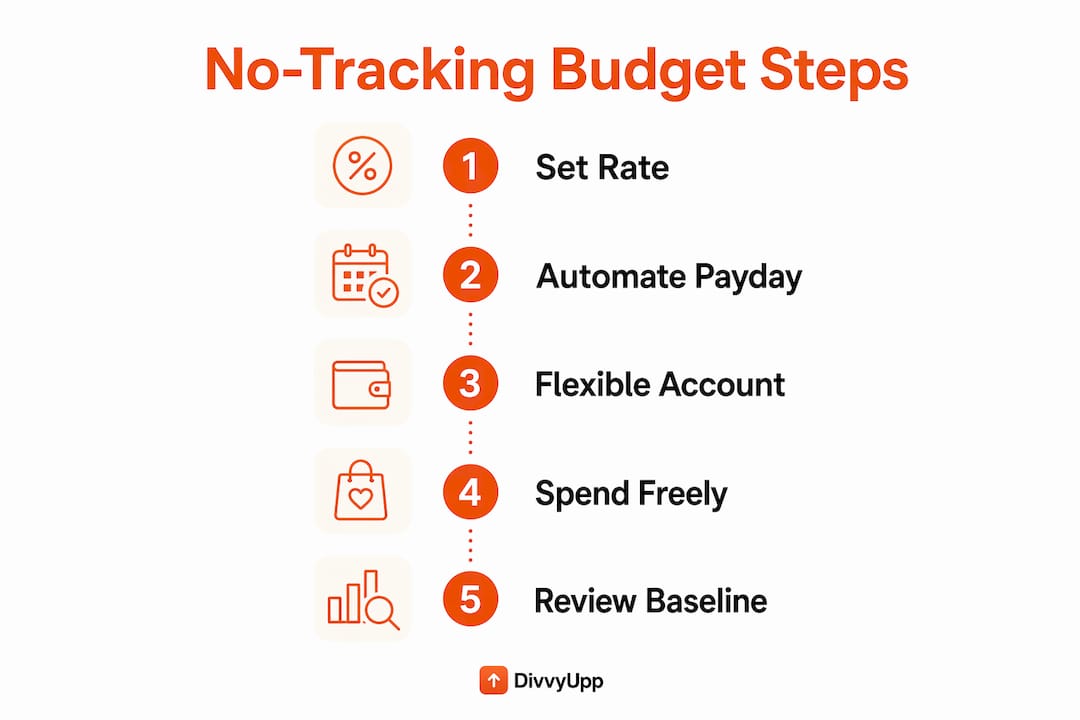
Step 1: Set your savings and investment rate
The anti-budget method recommends automating 20%–30% of your take-home pay into savings and investments first. That range covers most financial goals, from an emergency fund to retirement contributions. Pick a number that feels slightly uncomfortable but achievable.
Step 2: Automate everything on payday
Automated transfers on payday are the single most important step. Set up a transfer to your savings account, contributions to your 401(k) or IRA if not already payroll-deducted, and any fixed bill payments from your obligations account. Do this before you spend a dollar.

Step 3: Move the remainder to your flexible account
Whatever is left after savings and fixed bills transfers to your flexible spending account. This is your guilt-free spending pool for the entire pay cycle. Groceries, gas, dining, entertainment, and personal spending all come from here.
Step 4: Spend freely, check the balance weekly
You do not need to categorize anything. The only rule is: do not let the flexible account hit zero before the next payday. A weekly balance check of five minutes tells you whether you are on pace or need to slow down for the rest of the cycle.
Here is a sample pay-cycle flow for someone earning $6,000 per month after tax:
| Category | Amount | Method |
|---|---|---|
| Savings and investments (25%) | $1,500 | Automated transfer on payday |
| Fixed bills (rent, utilities, insurance) | $2,200 | Automated payments |
| Flexible spending | $2,300 | Transferred to spending account |
Step 5: Run a baseline review for the first 2–3 months
Looking back at 2–3 months of statements helps you calibrate your flexible spending amount. You are not tracking categories. You are checking whether the flexible balance consistently runs out early, which signals your savings rate is too aggressive, or whether you consistently have money left over, which signals you can save more.
Pro Tip: Use your bank's monthly summary view, not a transaction-by-transaction export. You want the total spent, not a line-by-line breakdown.
This method works best with predictable income and steady, recurring bills. Freelancers and commission earners can still use it, but they need to base their savings rate on their lowest expected monthly income, not their average.
What to do when the system breaks down
Most failures in non-tracking budgets come from unclear boundaries, not lack of discipline. The fix is almost always structural, not motivational.
The most common mistake is setting a savings rate that sounds impressive but leaves too little in the flexible account. When the spending account runs dry by the 20th of the month, the temptation is to conclude the method failed. The real fix is to reduce the savings rate by 5% and try again. Discipline is not the variable here. The math is.
Here are the most common problems and their solutions:
- Flexible account empties early: Reduce your savings rate by 5% for one cycle and see if the balance holds. You can always increase it again once the system stabilizes.
- Irregular expenses (car repairs, medical bills): Build a small "irregular expenses" sub-savings account funded by a separate automated transfer of $100–$200 per month. This keeps surprises from hitting your flexible account.
- Anxiety about not knowing where money goes: Run a single month of minimal tracking to identify any spending leaks, fix them, then stop tracking again. This is a diagnostic tool, not a permanent practice.
- Income varies month to month: Base your fixed transfers on your lowest expected paycheck. Treat any extra income as a bonus transfer to savings.
Pro Tip: If you run short two cycles in a row, that is a signal worth acting on. One short cycle is noise. Two in a row is a calibration problem.
The spending cycle is the unit of measurement here, not the individual transaction. Thinking in cycles rather than line items is the mindset shift that makes this method sustainable.
Why this method works: behavioral finance explains it
Budgeting without detailed tracking works because it reduces decision fatigue. Automation reduces micro-decisions, which reduces mental exhaustion and increases the likelihood you stick with the system long-term. Traditional reactive budgets ask you to make hundreds of small decisions every month. This method asks you to make a few big decisions once, then automate them.
The concept of financial slack explains the psychological benefit. When savings and bills are handled automatically, your discretionary spending decisions are no longer driven by urgency or anxiety. You spend based on what you actually value, not based on what you fear running out of. That shift in motivation produces better financial behavior over time.
The key behavioral advantages of this approach:
- Fewer decision points mean less opportunity for impulsive choices.
- Clear boundaries (the flexible account balance) replace vague willpower.
- Proactive design handles discipline upfront instead of relying on daily restraint.
- Reduced guilt comes from knowing savings are already covered before you spend anything.
This is why financial self-awareness built through system design outlasts financial self-awareness built through willpower. The system does not get tired. You do.
Key Takeaways
A budget without tracking every purchase works because automation handles discipline upfront, leaving a single flexible balance as the only number you need to manage.
| Point | Details |
|---|---|
| Automate savings first | Transfer 20%–30% of take-home pay to savings on payday before spending anything. |
| Use two accounts | Separate fixed obligations from flexible spending to eliminate daily category monitoring. |
| Watch one number | The flexible account balance is the only figure that requires regular attention. |
| Weekly check-in | A five-minute balance review each week keeps spending on pace without detailed logging. |
| Fix the math, not the mindset | If the account runs dry early, reduce the savings rate rather than blaming lack of discipline. |
Why I stopped tracking transactions and started designing systems
Srini / Founder @ DivvyUpp
I spent years trying to track every purchase. I used spreadsheets, apps, color-coded categories. I got good at tracking. I never got good at spending less. The tracking itself became the task, and the actual goal, which was building savings and feeling in control, stayed out of reach.
The shift happened when I stopped treating budgeting as a monitoring problem and started treating it as a design problem. Once savings moved automatically on payday, I stopped worrying about whether I was "on track." The track was built into the system.
What surprised me most was how much calmer I felt about spending once the boundaries were structural rather than self-imposed. Buying something from a flexible account that already had savings removed felt genuinely guilt-free. That feeling is not a trick. It is the correct response to a well-designed system.
The one thing I would tell anyone starting this method: be honest about your first flexible spending number. Set it generously at first. You can always tighten it. Starting too tight and failing in month one is the fastest way to abandon a system that would have worked with one small adjustment.
— Srini / Founder @ DivvyUpp
DivvyUpp gives you one number to watch, not a spreadsheet to fill
If the anti-budget method appeals to you but you want more precision than a raw bank balance, DivvyUpp was built for exactly that situation. It shows you a daily "safe-to-spend" number based on your real spending rate against the days left in your cycle, so you always know whether a purchase is safe, risky, or worth the cost.
DivvyUpp is non-custodial. Your money stays in your own bank. It never moves funds. It just answers the question "can I afford this?" with a straight answer instead of a spreadsheet. For anyone who wants to manage spending clearly without logging every transaction, the live demo at divvyupp.com/app requires no signup and takes about two minutes to try.
FAQ
What is budgeting without tracking every purchase?
It is a method, often called the anti-budget or no-budget budget, where you automate savings and fixed bills first and spend the remainder freely without logging individual transactions.
How much should I save before spending freely?
Most practitioners of the anti-budget method recommend automating 20%–30% of take-home pay into savings and investments before touching anything else.
What if my flexible spending account runs out before the month ends?
Reduce your savings rate by 5% for the next cycle. Running out early is a calibration issue, not a discipline failure. Adjust the math and the system corrects itself.
Do I ever need to track transactions with this method?
A brief review of 2–3 months of bank statements helps you set an accurate baseline when you first start. After that, minimal tracking is only useful as a short-term diagnostic if something feels off.
Is this method suitable for variable income?
It works with variable income if you base your automated transfers on your lowest expected monthly paycheck. Any income above that amount can go to savings as a bonus transfer.
General information, not financial advice.