
TL;DR:
Simplifying personal finance in 2026 involves reducing decisions through account consolidation, automation, and setting one specific goal each quarter.
A minimalist system with three accounts can lower monthly decision time from hours to minutes while increasing interest income with better savings choices.
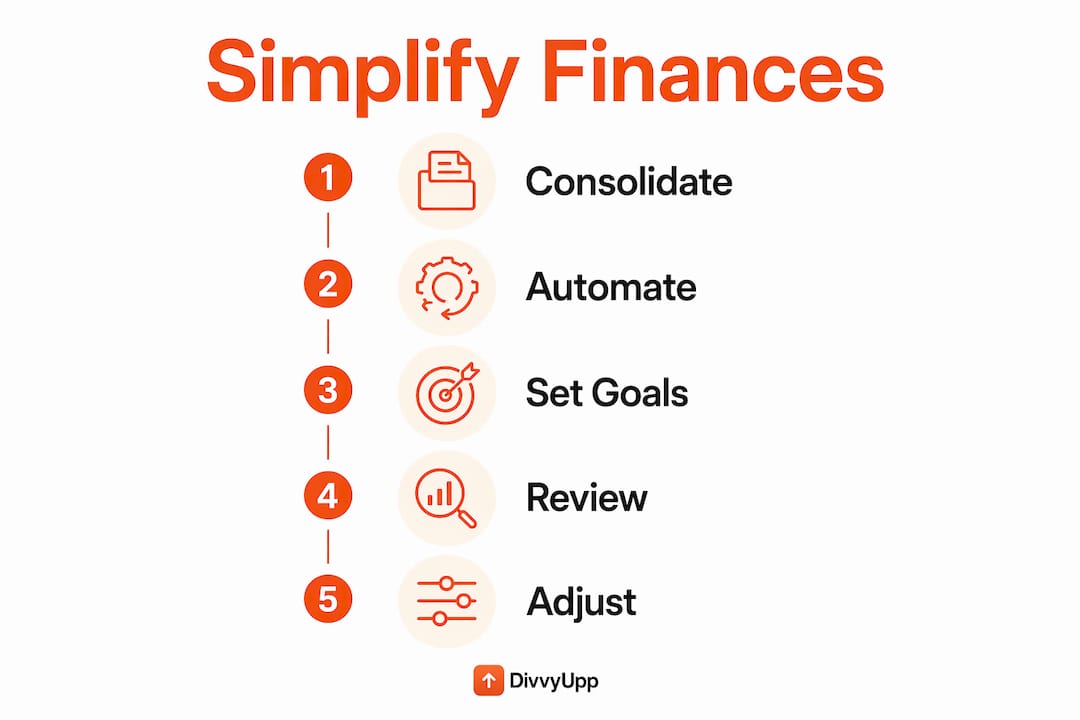
Simplifying personal finance in 2026 means cutting the number of decisions you make about money each month, not cutting your lifestyle. The standard approach to personal finance, which is categorizing every transaction after the fact and building elaborate spreadsheets, creates more stress than it prevents. The strategies that actually work in 2026 center on three moves: consolidating accounts, automating transfers, and setting one specific goal per quarter. Each move reduces what behavioral economists call decision fatigue, the mental drain that causes you to make worse financial choices as the day goes on.
How to simplify personal finance in 2026 by consolidating accounts
Account consolidation is the fastest way to reduce financial complexity. The typical American household holds 5.3 accounts, which creates 30 or more monthly decision points. A minimalist system cuts that to 3–5 decisions per month.

The target setup is three accounts: one checking for daily spending, one high-yield savings account (HYSA) for your emergency fund and short-term goals, and one brokerage for long-term investing. That’s it. Every financial goal you have fits inside this structure.
The interest rate difference alone makes consolidation worth it. Moving $20,000 from a standard checking account earning 0.07% APY to a HYSA earning 4%+ adds over $800 per year in interest income. That’s money you were leaving on the table by keeping funds in the wrong place.
What a minimalist account setup looks like
| Account type | Purpose | Target balance |
|---|---|---|
| Checking | Bills, daily spending | 1 month of expenses |
| High-yield savings | Emergency fund, short-term goals | 3–6 months of expenses |
| Brokerage | Long-term investing | Ongoing contributions |
Consolidating also reduces monthly admin time from 3–4 hours down to 15–20 minutes. That’s not a minor convenience. It’s the difference between a financial system you actually maintain and one you abandon by February.
Pro Tip: Use an app that syncs all three accounts into one dashboard. App-based syncing prevents the budget abandonment that kills manual spreadsheet tracking within 30 days.
How does automating your finances eliminate decision fatigue?
Automation is the single most effective money management strategy in 2026. Automating transfers on payday cuts 80–90% of monthly financial decisions. That reduction means fewer moments where willpower and good intentions have to carry the load.
The setup is straightforward. On payday, three transfers fire automatically: one to your HYSA for savings, one to your brokerage for investing, and one to cover any upcoming large bills. What remains in checking is your spending money for the cycle. You never have to decide whether to save this month because the decision is already made.
One critical warning applies to autopay. Setting autopay to the minimum payment on credit cards is a trap. Autopay minimum payers pay off 8–17% less of their balances than people who pay manually. Set autopay to the full statement balance, not the minimum.
Here’s the sequence to set up in one afternoon:
-
List every recurring bill with its due date and amount.
-
Schedule autopay for each bill two days before the due date.
-
Set a savings transfer for the day after payday.
-
Set an investment transfer for the same day as the savings transfer.
-
Leave the checking balance as your spending ceiling for the cycle.
Pro Tip: Schedule a 30-minute quarterly review to adjust your automation amounts. Costs change, income changes, and automation set once and forgotten can quietly drift out of alignment with your actual goals.
What makes specific financial goals succeed where vague ones fail?
Vague goals fail because they have no finish line. “Save more” and “spend less” are intentions, not goals. Setting one specific, measurable goal per quarter with a hard deadline is what separates people who make progress from people who stay stuck.
A strong quarterly goal has three parts: a dollar amount, a deadline, and a single account it affects. For example: “Pay off $1,500 on my Visa card by September 30.” That goal tells you exactly what to do, when to do it, and how to measure success. “Get out of debt” tells you none of those things.
Your 2026 goal menu might include:
-
Increase your 401(k) contribution by 1% before the end of Q3
-
Add $2,000 to your HYSA emergency fund by October 1
-
Pay off one credit card balance completely before December 31
-
Max your Roth IRA contribution ($7,500 for 2026) before the tax deadline
A financial goal timeline maps each goal to a specific month, which prevents the common mistake of stacking too many goals into Q4 when motivation typically drops. Breaking a large goal into monthly milestones also keeps momentum alive. Paying off $4,800 in credit card debt feels abstract. Paying off $400 per month for 12 months feels manageable.
Pro Tip: Write your one quarterly goal on a sticky note and put it on your monitor. Physical visibility beats app notifications for keeping a goal top of mind.
How to do a mid-year financial reset in 2026
A mid-year reset is a structured audit of the past six months. It answers one question: are you on track, or do you need to adjust? Rising costs for food and gas in 2026 make budgeting feel like running on a treadmill, which means a mid-year check is not optional. It’s the mechanism that keeps your plan connected to reality.
Work through these five areas in order:
-
Spending review. Pull your last six months of transactions and find the two or three categories where you consistently overspent. Takeout, subscriptions, and travel are the most common culprits. Pick one to cut.
-
401(k) check. The 2026 annual 401(k) limit is $23,500 ($31,000 if you’re 50 or older). Your mid-year target contribution is $11,750. If you’re behind, increase your contribution rate now rather than trying to catch up in December.
-
Subscription audit. List every recurring subscription charge from the past 90 days. Cancel anything you haven’t used in the past 30 days. Most people find $50–$150 per month in forgotten charges.
-
Tax estimate. If you have freelance income, investment gains, or a side business, estimate your 2026 tax bill now. Underpayment penalties are avoidable if you act in July rather than April.
-
Q3 goal. Set one specific, achievable goal for the next 90 days with a deadline. Write it down.
Your emergency fund target for 2026 is 3–6 months of essential expenses, covering rent, utilities, food, debt payments, and transportation. If your HYSA balance falls short of the three-month floor, that becomes your Q3 goal automatically.
| Mid-year checkpoint | 2026 target | Action if behind |
|---|---|---|
| 401(k) contributions | $11,750 by July | Increase payroll deduction now |
| Emergency fund | 3–6 months of expenses | Redirect one discretionary category |
| Subscription spend | Zero unused services | Cancel within 48 hours of audit |
| Tax estimate | Quarterly payments current | Pay estimated tax by September 15 |
Key Takeaways
The most effective way to manage money in 2026 is to reduce decisions through consolidation, automation, and one specific quarterly goal reviewed at mid-year.
| Point | Details |
|---|---|
| Consolidate to three accounts | One checking, one HYSA, one brokerage covers every financial need with minimal admin. |
| Automate on payday | Savings and investment transfers that fire automatically remove willpower from the equation. |
| One goal per quarter | Specific targets with deadlines outperform vague intentions every time. |
| Mid-year reset is mandatory | A July audit catches drift before it becomes a year-end crisis. |
| HYSA interest advantage | Moving $20,000 to a 4%+ HYSA adds over $800 per year in interest income. |
The part most finance articles won’t tell you
I built DivvyUpp because I watched smart, high-earning people fail at budgeting. Not because they lacked discipline. Because their systems were too complicated to maintain under real-life pressure.
The consolidation and automation advice in this article is correct. But here’s what I’ve seen trip people up: they set the system up perfectly in january, and then life happens in march. An unexpected expense, a job change, a bad month. The system breaks, they feel like failures, and they abandon it entirely.
The fix is not a better spreadsheet. It’s a daily number. When you know what’s actually safe to spend today, based on your real spending rate against the days left in your cycle, you stop making the micro-decisions that blow up a budget. You don’t need to remember your categories or check your app 12 times a day. You just need one honest answer to “can I afford this?”
That’s the mindset shift that makes spending cycle best practices stick. Simplification is not about perfection. It’s about reducing the number of moments where you have to choose between what you want now and what you want most. The fewer those moments, the better your outcomes.
— Srini / Founder @ DivvyUpp
What DivvyUpp adds to your 2026 financial system
The consolidation and automation strategies above give you a solid foundation. DivvyUpp fills the gap those strategies leave open: the daily spending decisions that happen between paydays.
DivvyUpp is a non-custodial personal finance app that gives you a single daily “safe-to-spend” number based on your actual spending rate and the days remaining in your cycle. It answers “can I afford this?” with a straight answer: safe, risky, or yes-but-here’s-the-cost. Your money never leaves your own bank. DivvyUpp doesn’t move funds or store your account details. It just gives you the number you need before you spend, not after the statement arrives. Try it free during beta or run the live demo at divvyupp.com/app with no signup required.
FAQ
What is the fastest way to simplify personal finances?
Consolidating to three accounts (checking, HYSA, brokerage) and automating transfers on payday cuts monthly financial decisions by 80–90%. That single structural change removes more friction than any budgeting technique.
How much should my emergency fund hold in 2026?
The 2026 standard is 3–6 months of essential expenses, covering rent, utilities, food, debt payments, and transportation. Keep this fund in a HYSA earning 4%+ to maximize interest while maintaining liquidity.
What is the 2026 401(k) contribution limit?
The 2026 annual 401(k) limit is $23,500, or $31,000 for people aged 50 and older. Your mid-year checkpoint target is $11,750 contributed by July.
Why do vague financial goals fail?
Vague goals like “save more” have no measurable endpoint, so there’s no way to track progress or feel success. Specific goals with dollar amounts and deadlines create accountability and make it clear when you’ve won.
How often should I review my automated financial system?
A quarterly review of 30 minutes is enough to keep automation aligned with your current income, expenses, and goals. Set a calendar reminder for the first week of each new quarter.
General information, not financial advice.