
TL;DR:
- Financial self-awareness involves objectively recognizing your financial status and understanding the emotions behind your money habits. Building this awareness through routine check-ins and emotional logging enhances decision-making and reduces impulsive spending. This skill improves financial outcomes more effectively than knowledge alone.
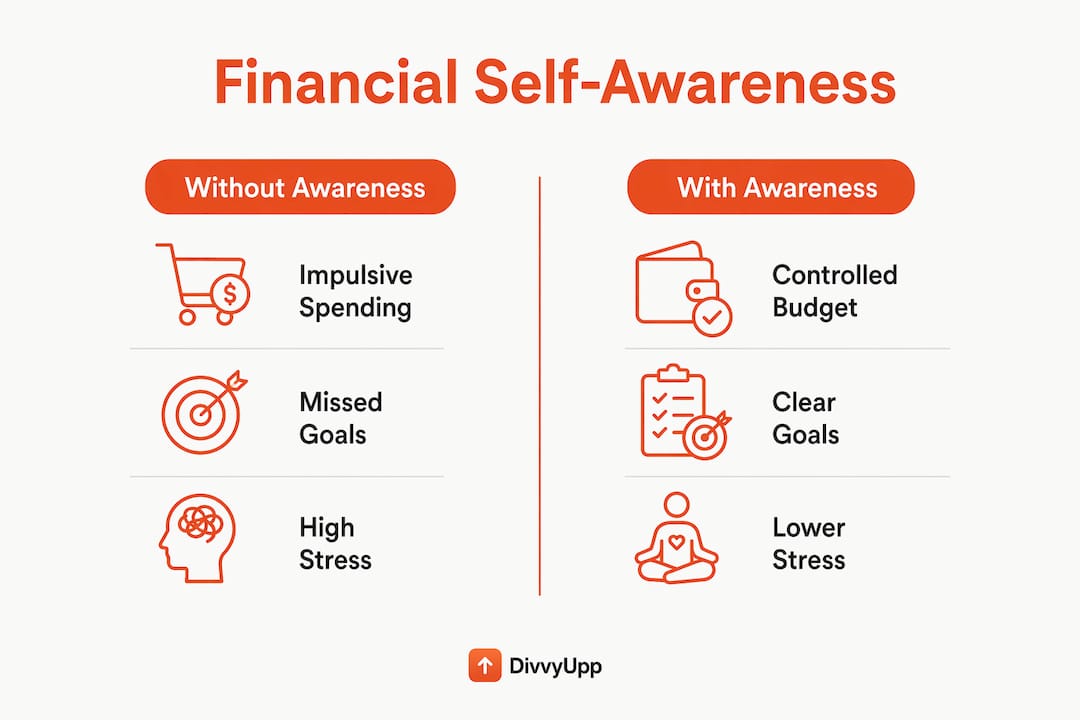
Financial self-awareness is the ability to observe and accept your current financial reality, including your income, spending, assets, liabilities, and the emotions and habits driving your choices, without judgment. The term is sometimes called financial mindfulness or financial consciousness, but the core idea is the same: you cannot change what you refuse to see clearly. Most people know roughly what they earn. Far fewer understand why they spend the way they do. That gap is exactly where financial self-awareness lives, and closing it is the first step toward making better money decisions.
What is financial self-awareness and what does it include?
Financial self-awareness is defined as the conscious recognition of both your objective financial state and the psychological patterns shaping your behavior around money. Investopedia describes financial mindfulness as being highly aware of your objective financial situation combined with genuine acceptance of that situation. Acceptance here is not resignation. It means you look at the numbers without flinching, so you can actually do something about them.
The concept covers two distinct layers:
-
Objective layer: Your income, monthly spending, total assets, outstanding liabilities, and net worth. These are the facts.
-
Psychological layer: The emotions, habits, and triggers that push you toward or away from spending. These are the forces behind the facts.
Both layers matter equally. You can know your credit card balance and still swipe impulsively after a stressful day at work. That gap between knowing and doing is a psychological one, not a math one.
“Financial self-awareness requires observing your spending patterns and emotional triggers around money with curiosity rather than criticism. Curiosity opens the door to change; criticism slams it shut.”
The importance of financial awareness shows up in outcomes. Research published in Springer Nature finds that deficits in financial self-control and self-efficacy increase impulsive spending and financial hardship, which directly damages financial well-being. Put plainly: people who cannot observe their own patterns tend to repeat the costly ones.

How is financial self-awareness different from financial literacy?
Financial literacy and financial self-awareness are related but separate skills. Confusing them is one of the most common mistakes people make when trying to improve their finances.
Financial literacy is defined as the knowledge and understanding of financial concepts: how compound interest works, what a Roth IRA is, how to read a credit report. It is the information layer.
Financial self-awareness is a metacognitive skill. It means watching yourself interact with money and noticing what you actually do versus what you know you should do. The OECD distinguishes these constructs by emphasizing that metacognitive recognition of behaviors and emotions is a separate competency from financial knowledge alone.
Here is a practical sequence that shows the difference:
-
Literacy: You know that carrying a credit card balance costs you interest every month.
-
Self-awareness: You notice that you consistently carry a balance in december and january, and you recognize it happens because holiday spending triggers an “I’ll deal with it later” feeling.
-
Action: Because you spotted the pattern and its emotional root, you set a spending limit in november before the trigger hits.
Step one is literacy. Steps two and three require self-awareness. Both are necessary. Literacy without self-awareness gives you knowledge you never apply. Self-awareness without literacy leaves you emotionally attuned but technically uninformed. The strongest financial decisions come from combining both.
What strategies effectively build financial self-awareness?
Financial self-awareness is a habitual practice, not a one-time budgeting session. Investopedia confirms that sustained awareness requires routine practices, repeated observation, and mindful decision moments over time. The following habits build that practice:
-
Weekly money check-ins. Set aside 15 minutes each week to review your income, spending, and account balances. The goal is not to judge what you find. The goal is to see it clearly. Regularity matters more than duration.
-
Mindful pauses before purchases. Before any non-essential purchase, ask one question: does this align with what I actually want my money to do? A three-second pause is enough to interrupt an automatic spending response.
-
Emotional trigger logging. After each significant purchase, write one sentence about how you felt before you bought it. Bored, stressed, celebratory, anxious. Over weeks, patterns emerge. Linking awareness to decision points like this builds immediate behavioral feedback and prevents impulsive spending from repeating.
-
Non-judgmental review. When you find a spending pattern you dislike, treat it as data, not evidence of failure. Investopedia stresses acceptance without blame as the operational goal for awareness to succeed. Self-criticism causes people to avoid their finances entirely, which makes everything worse.
-
Goal alignment checks. Once a month, compare your actual spending to your stated goals. Saving more, paying down debt, building an emergency fund. The gap between intention and action is where self-awareness does its most useful work.
Pro Tip: Set a recurring calendar reminder titled “Money Check-In” for the same day each week. Consistency builds the habit faster than motivation ever will.
How do behavioral biases and emotions influence financial decisions?
Behavioral biases are systematic errors in thinking that affect financial choices, often without the person realizing it. A 2025 behavioral finance study finds that awareness of emotions and biases improves decision-making, especially when combined with financial literacy. The two reinforce each other.
Common biases that financial self-awareness helps you catch include:
-
Present bias: Valuing immediate spending over future savings, even when you know the math favors saving.
-
Loss aversion: Holding a losing investment too long because selling feels like admitting failure.
-
Anchoring: Judging a $200 item as cheap because you just looked at a $500 version of the same thing.
-
Emotional spending: Using purchases to manage stress, boredom, or social pressure rather than genuine need.
None of these biases disappear simply because you know they exist. But naming them in the moment gives you a fraction of a second to choose differently.
“Awareness of your emotional state before making a financial decision improves outcomes. The emotion does not have to go away. You just have to see it clearly enough to act with intention rather than impulse.”
Self-regulation theory explains why this works: financial behavior improves through ongoing feedback loops that compare your current state to your goals and prompt corrective action. Without awareness, those feedback loops never activate. You spend, the statement arrives, you feel bad, and the cycle repeats. With awareness, you interrupt the cycle before the damage is done.
Practical applications: how financial self-awareness improves money management
Financial self-awareness produces concrete, measurable improvements in how you handle money. The benefits of financial self-knowledge show up across several areas:
| Area | Without self-awareness | With self-awareness |
|---|---|---|
| Spending control | Impulsive purchases, surprise shortfalls | Mindful pauses, fewer regret purchases |
| Saving | Intentions without follow-through | Behavior aligned with stated goals |
| Debt management | Minimum payments, avoidance | Clear picture of balances and payoff timeline |
| Financial shocks | Caught off guard, reactive | Planned buffers, faster recovery |
| Investment decisions | Emotion-driven buying and selling | Pattern recognition reduces costly errors |
The most common scenario where self-awareness pays off is lifestyle creep. You get a raise, your spending rises to match it, and six months later you feel just as financially tight as before. Financial well-being frameworks distinguish between the capacity to manage finances and the ability to understand your own behavioral patterns. Lifestyle creep is a behavioral pattern problem, not an income problem. Awareness catches it early.
Pro Tip: After any income increase, write down one specific financial goal you want that extra money to serve before you spend a dollar of it. This single step prevents most lifestyle creep.
Regular money check-ins at DivvyUpp give you a real-time view of your spending rate against the days left in your cycle, which makes the abstract practice of self-awareness concrete and immediate.
Key Takeaways
Financial self-awareness is the combination of clear-eyed observation of your financial facts and honest recognition of the emotions and habits driving your behavior, and it produces better financial outcomes than financial literacy alone.
| Point | Details |
|---|---|
| Definition of self-awareness | It means observing your financial facts and emotional patterns together, without judgment. |
| Different from literacy | Literacy is knowledge; self-awareness is watching how you actually behave with that knowledge. |
| Core practice | Weekly check-ins and emotional trigger logging build the habit over time. |
| Bias reduction | Naming biases like present bias or loss aversion in the moment gives you a chance to choose differently. |
| Practical impact | Self-awareness closes the gap between financial intentions and actual behavior across spending, saving, and debt. |
Why I think most people skip the hardest part of financial awareness
I built DivvyUpp because I was the person who knew the right answers and still overspent every month. I understood compound interest. I had a budget. I just never looked at it honestly until after the damage was done.
The hardest part of financial self-awareness is not the tracking. It is the non-judgmental part. Every time I reviewed my spending and found something I did not like, my first instinct was to feel bad about it and close the app. That reaction is exactly what kills financial progress. Shame is not a feedback loop. It is an exit ramp.
What actually worked for me was treating each review like a scientist looking at data. Not “I failed again” but “interesting, I spent $400 on restaurants in the third week of the month. What was happening that week?” That shift from self-criticism to curiosity changed everything. The pattern became visible. Once it was visible, I could do something about it.
The other thing I underestimated was how much routine matters. A single honest financial review does almost nothing. Fifty of them, done consistently over a year, rewire how you think about money. The goal is not perfection in any one month. The goal is showing up to look at the numbers, week after week, without flinching.
If you are a high earner who still feels financially stretched at the end of every month, the problem is almost never income. It is the gap between what you intend to do with your money and what you actually do. Self-awareness is the only tool that closes that gap.
— Srini / Founder @ DivvyUpp
DivvyUpp gives your financial self-awareness a daily anchor
Understanding your financial patterns is one thing. Seeing them update in real time is another.
DivvyUpp shows you a single daily safe-to-spend number based on your actual spending rate and the days left in your cycle. When you ask “can I afford this?” it answers directly: safe, risky, or yes-but-here’s-the-cost. Your money never moves. DivvyUpp is non-custodial and never touches your bank account. It just gives you the honest number you need to make a mindful decision before you spend, not after the statement lands. Try DivvyUpp free, no signup required.
General information, not financial advice.
FAQ
What is financial self-awareness in simple terms?
Financial self-awareness is the ability to see your income, spending, and financial habits clearly and understand the emotions driving your choices. It combines objective financial facts with honest observation of your own behavior.
How is financial self-awareness different from budgeting?
Budgeting is a tool; self-awareness is the mindset that makes budgeting work. Without self-awareness, most people build a budget and abandon it within weeks because they never address the behavioral patterns underneath.
How do I improve my financial self-awareness?
Start with a weekly 15-minute money check-in reviewing your income and spending, and log one sentence about how you felt before each significant purchase. Routine observation builds the habit faster than any single review.
Can financial self-awareness reduce impulsive spending?
Yes. Research confirms that deficits in financial self-control increase impulsive spending and financial hardship. Tracking emotional triggers at the point of purchase creates a feedback loop that interrupts automatic spending responses.
Do I need to be good at math to develop financial self-awareness?
No. Financial self-awareness is a behavioral and emotional skill, not a math skill. The numbers matter, but the more important work is observing why you make the choices you make.