
TL;DR:
- A spending habit mismatch involves a fundamental difference in daily financial behaviors between individuals or partners, often causing recurring conflict. Addressing this mismatch requires structural solutions like clear spending limits and systems that respect different money scripts, rather than moral judgments or willpower alone.
A spending habit mismatch is defined as a fundamental difference in daily money behaviors between individuals or partners, most commonly the saver-spender dynamic, that creates recurring conflict and undermines shared financial goals. The term is informal but widely used in personal finance and couples therapy circles. The clinical equivalent is "financial incompatibility," though behavioral economists often frame it as a "tightwad-spendthrift polarity." Whatever you call it, 45% of couples report arguing about money at least sometimes. That number signals how common these mismatches are, and how much damage they cause when left unaddressed.
What is a spending habit mismatch, exactly?
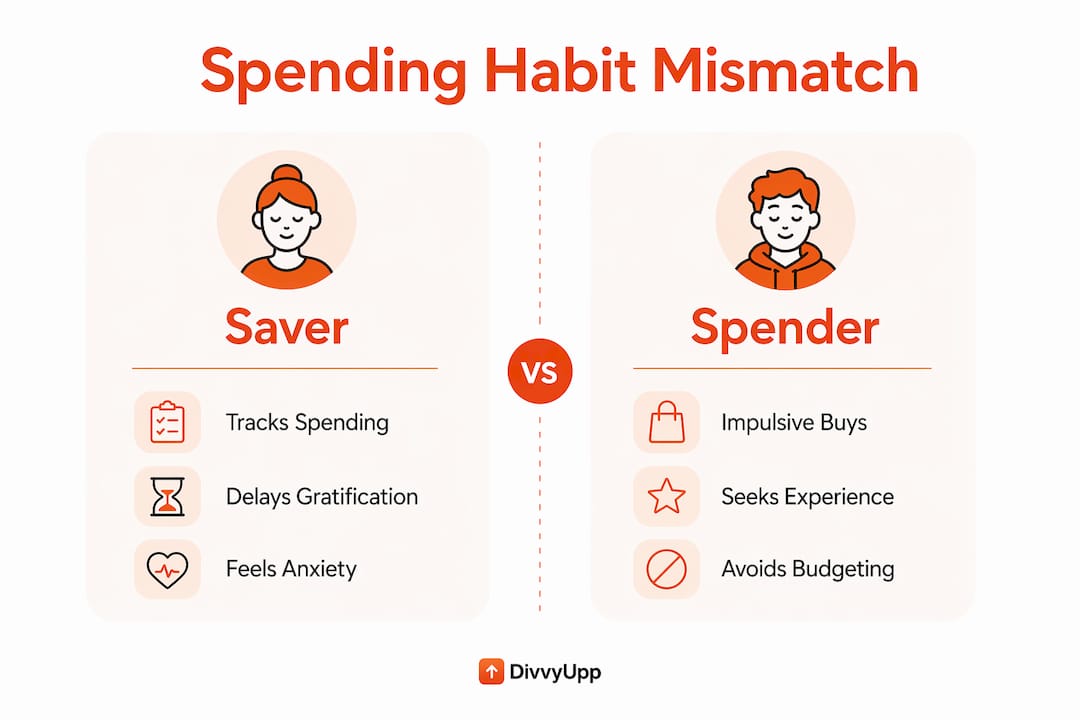
A spending habit mismatch occurs when two people, or even one person split between competing financial goals, operate from fundamentally different money scripts. One person treats spending as a source of joy or freedom. The other treats saving as a source of security and control. Neither approach is wrong. The conflict arises when both scripts collide without a shared framework to manage the tension.

The mismatch shows up in predictable patterns. A saver tracks every dollar, delays gratification, and feels anxiety when the balance drops. A spender prioritizes present experience, resists rigid budgets, and feels controlled when spending is restricted. These aren't personality flaws. They are deeply rooted financial behaviors shaped over years of lived experience.
The problem compounds when neither person recognizes the pattern. Each side interprets the other's behavior as irresponsible or joyless. The real issue is not the spending itself. The real issue is the absence of a shared system that respects both styles.
Why do spending behavior conflicts run so deep?
90% of financial behaviors are driven by emotions rather than rational economic analysis. That single fact reframes the entire conversation. Spending conflicts are almost never about math. They are about psychological needs: security, freedom, identity, and belonging.
Therapists who work with couples on money consistently observe that saver-spender conflicts are shadowed by shame and projection rooted in family-of-origin experiences. A person raised in financial scarcity may hoard money as a defense mechanism. A person raised with strict financial control may spend freely as an act of rebellion. Neither behavior is a conscious choice. Both are emotional responses to old experiences playing out in the present.
"Spending habit mismatches often mask deeper personal issues such as shame and family-of-origin trauma. Addressing these underlying dynamics is the key to lasting change."
This is why moralizing spending habits backfires. Telling a spender they are "irresponsible" or a saver they are "cheap" triggers shame, not change. Shame shuts down conversation and entrenches behavior. The more productive frame is to treat saving and spending as complementary poles, each with genuine benefits and genuine risks, rather than as a right-versus-wrong debate.
- Savers gain security and long-term stability but risk rigidity, missed experiences, and resentment.
- Spenders gain joy, flexibility, and present-moment richness but risk debt accumulation and goal erosion.
- The mismatch itself creates a natural check-and-balance when managed well, and a destructive cycle when ignored.
How to identify spending habits and spot the mismatch
The most reliable method for a spending habits assessment starts with a 3–6 month review of actual transactions. Experts recommend categorizing spending into three buckets: needs, wants, and savings, then applying the 50/30/20 rule as a benchmark.
The 50/30/20 framework allocates 50% of after-tax income to needs, 30% to wants, and 20% to savings or debt repayment. Deviations from this benchmark reveal the mismatch. A person spending 45% on wants and saving 5% has a clear gap between behavior and goal. A person saving 35% but spending almost nothing on wants may be building wealth at the cost of quality of life and relationship friction.
| Spending pattern | Typical behavior | Risk to financial goals |
|---|---|---|
| Impulsive spender | Frequent small purchases, stored card info, no review | Savings gap, debt accumulation |
| Restrictive saver | Avoids all discretionary spending, rigid budget | Burnout, resentment, unsustainable |
| Balanced spender | Reviews monthly, uses spending limits, adjusts | Lowest long-term conflict risk |
| Reactive spender | Spends under stress or boredom, not by plan | Unpredictable cash flow, goal drift |
Recognizing spending patterns requires more than one month of data. One month captures noise. Three to six months reveals the actual habit.
Pro Tip: Apply the 24-hour rule to any nonessential purchase above a set threshold, say $50 or $100. Waiting forces real-time emotional awareness and breaks the impulse cycle before it hits your account.
A second practical tool is the daily spending limit framework, which converts monthly budgets into a single daily number. This makes the abstract concrete. Instead of asking "am I on track this month," you ask "what can I safely spend today?" That shift in framing changes behavior faster than any spreadsheet.
What approaches actually work for managing financial mismatch issues?
The most durable solution to a spending habit mismatch is not conversion. The goal is not to turn a spender into a saver or vice versa. Polarity management treats saving and spending as complementary forces that must be balanced, not eliminated. This framework maps the benefits and risks of both extremes, then identifies warning signs when either pole dominates too heavily.
Practically, this means building systems that give each style room to operate without undermining the other. Several approaches consistently reduce conflict and improve goal adherence:
- Hybrid financial structure: Cover shared essential expenses from a common pool, then give each person a defined personal discretionary fund. Separate spending allowances reduce resentment and increase budget adherence because neither person feels controlled.
- Choice architecture: Adjust the friction around spending decisions. Delete stored card information from retail sites. Move savings to a separate account on payday. These structural changes work because willpower alone is insufficient for sustained behavior change.
- Scheduled money conversations: Set a fixed time each month to review spending together. This removes the emotional charge from in-the-moment conflicts and creates a predictable, low-stakes forum for adjustment.
- Named spending categories: Give discretionary spending a label and a cap. "Fun money" with a $200 monthly limit feels very different from an open-ended credit card. The label creates psychological permission without unlimited access.
Pro Tip: If you find yourself overspending in one category repeatedly, don't cut it entirely. Reduce it by 20% and track for 60 days. Gradual reduction sticks. Cold-turkey cuts usually don't.
The deeper principle is that financial mismatch issues require structural solutions, not moral ones. Shaming a spender into saving rarely works. Building an environment where saving happens automatically, and spending has defined guardrails, does.
How do spending habit mismatches affect saving, debt repayment, and early retirement?
A persistent spending behavior conflict directly erodes the financial behaviors needed for long-term goals. Saving requires consistency. Debt repayment requires discipline. Early retirement, particularly the FIRE framework, requires both at a high level for years. A mismatch that goes unmanaged chips away at all three.
The damage shows up in specific ways:
- Savings gaps: When spending regularly exceeds the planned 20% savings allocation, compounding works against you instead of for you. A small monthly shortfall becomes a large retirement gap over a decade.
- Debt accumulation: Impulsive spending without a real-time spending signal leads to end-of-month surprises. Those surprises often get covered by credit, which adds interest cost and delays debt repayment goals.
- Goal drift: Without a clear daily number connecting today's spending to a long-term target, abstract goals like "retire at 55" stay abstract. They don't influence Tuesday's lunch decision.
- Decision fatigue: Constant internal conflict between spending and saving depletes the mental energy needed for good financial decisions. Structure removes the need for repeated willpower.
Understanding your financial goal timeline is the first step toward connecting daily spending decisions to long-term outcomes. When you know exactly how much you need to save each month to hit a retirement date, the daily spending number becomes meaningful rather than arbitrary.
Key Takeaways
A spending habit mismatch is a structural problem, not a character flaw, and it requires structural solutions: clear spending limits, defined personal funds, and systems that make the right behavior the easy behavior.
| Point | Details |
|---|---|
| Define the mismatch clearly | A spending habit mismatch is a saver-spender polarity, not a moral failing, rooted in emotional needs. |
| Emotions drive behavior | 90% of financial behaviors are emotion-driven, so shame-based approaches consistently backfire. |
| Use a 3–6 month review | Categorize spending into needs, wants, and savings using the 50/30/20 rule to spot real deviations. |
| Build structural guardrails | Choice architecture, like removing stored card info, outperforms willpower for lasting behavior change. |
| Connect daily spending to goals | A daily safe-to-spend number links today's decisions to long-term targets like debt payoff or early retirement. |
The uncomfortable truth about spending mismatches
Srini / Founder @ DivvyUpp
The thing I've noticed, both personally and in building DivvyUpp, is that most people approach a spending mismatch as a knowledge problem. They think if they just understood budgeting better, or if their partner understood it better, the conflict would resolve. It doesn't work that way.
The mismatch is almost always a values problem wearing a math costume. One person values security. The other values experience. Neither value is wrong. The problem is that nobody named the values out loud, so the conflict plays out through arguments about specific purchases instead of honest conversations about what money actually means to each person.
What I've found actually works is separating the conversation from the transaction. Don't argue about the $200 dinner. Talk, at a calm scheduled moment, about what that dinner represents to each of you. One person sees waste. The other sees connection and celebration. Both are real. Both matter. The system you build has to honor both.
I also want to push back on the idea that the goal is financial harmony in some idealized sense. The goal is a system that functions even when you disagree. Disagreement is permanent. A good financial structure makes disagreement manageable rather than catastrophic. That's the actual target.
— Srini / Founder @ DivvyUpp
DivvyUpp gives you a daily spending number, not a lecture
Knowing you have a spending habit mismatch is useful. Having a number that tells you exactly what is safe to spend today is what actually changes behavior.
DivvyUpp calculates your daily safe-to-spend figure based on your real spending rate and the days left in your billing cycle. It answers one question: "Can I afford this?" The answer is safe, risky, or yes-but-here's-the-cost. Your money never leaves your own bank. DivvyUpp never moves funds or stores card numbers. It just gives you clarity before you spend, not regret after the statement lands. If you have a savings goal, a debt payoff target, or a FIRE date in mind, try DivvyUpp and see what your number looks like today.
General information, not financial advice.
FAQ
What is a spending habit mismatch in simple terms?
A spending habit mismatch is when two people, or one person with conflicting financial goals, have fundamentally different daily approaches to money, typically a saver-spender dynamic that creates recurring conflict.
Can a spending habit mismatch affect individual financial goals, not just relationships?
Yes. Even solo, a mismatch between your current spending behavior and your savings or debt repayment goals creates the same friction, eroding consistency and making long-term targets like early retirement harder to reach.
How do I identify my own spending habits accurately?
Review 3–6 months of actual transactions and categorize them into needs, wants, and savings. Compare your percentages against the 50/30/20 rule to see where your behavior deviates from your stated goals.
Does willpower fix a spending habit mismatch?
No. Willpower is a limited resource. Structural interventions, like automated savings transfers, spending limits, and removing stored card information, produce more reliable behavior change than relying on self-control alone.
What is the fastest way to reduce spending behavior conflicts?
Define a personal discretionary fund with a fixed monthly cap for each person. Separate spending allowances reduce resentment and increase budget adherence without requiring either person to abandon their money style.