
A financial goal timeline is a structured schedule that links specific money objectives to realistic deadlines, turning vague intentions into monthly savings targets you can actually hit. Most people set goals like “save more” or “pay off debt” without attaching a date or a dollar amount per month. That gap between intention and execution is exactly where financial plans collapse. A well-built timeline uses frameworks like SMART goals and budgeting baselines such as the 60/30/10 rule to make every goal measurable, time-bound, and funded from your real income.
What is a financial goal timeline and why does it matter?
A financial goal timeline is the standard planning tool that defines when each money objective should be reached and how much you need to save each month to get there. Financial planners call this a “time horizon framework,” and it does two things at once: it tells you what to save and it tells you where to put that money based on how soon you need it.
The timeline matters because it changes your behavior before you spend, not after. Without a deadline attached to a goal, most people treat their checking account as one undifferentiated pool of money. A timeline splits that pool into purpose-driven buckets. Each bucket has a name, a date, and a monthly contribution. That structure alone reduces impulsive spending because you can see exactly what each dollar is already committed to.

Goal timelines also shape investment strategy, shifting focus from capital preservation for near-term goals to growth-oriented assets for goals a decade away. That means the timeline is not just a calendar. It is a decision-making tool that determines risk tolerance, account type, and savings rate all at once.
How do timeframes for financial goals influence your planning?
Financial goals fall into three categories based on when you need the money, and each category demands a different approach.
Short-term goals have a horizon under one year. Examples include building a $1,000 emergency starter fund, saving for a vacation, or covering a car repair. Short-term goals require liquid, low-volatility accounts like high-yield savings or money market accounts. You cannot afford to lose principal on money you need in six months.
Medium-term goals span one to five years. Saving for a home down payment, funding a wedding, or paying off a car loan all fit here. These goals tolerate slightly more risk, but capital preservation still takes priority over growth.
Long-term goals extend beyond five years. Retirement savings, college funding, and financial independence (FIRE) goals belong in this category. Long-term horizons favor growth investments because time absorbs market volatility and compounding works in your favor.
| Goal type | Typical timeline | Suitable approach | Example |
|---|---|---|---|
| Short-term | Under 1 year | High-yield savings, money market | Emergency fund, vacation |
| Medium-term | 1–5 years | Balanced savings and low-risk funds | Home down payment, wedding |
| Long-term | 5+ years | Growth investments, retirement accounts | Retirement, college fund |
The table above shows why timeframe is the first question to answer when you create a financial goal plan. Get the horizon wrong and you either take too much risk or leave too much growth on the table.
How to set a financial goal timeline using SMART and budgeting rules
The SMART framework turns a wish into a plan. SMART stands for Specific, Measurable, Achievable, Relevant, and Time-bound. Every financial goal you set should pass all five tests before you commit a dollar to it.
The math behind a SMART timeline is straightforward. Divide your total goal cost by the number of months in your timeline to get your required monthly savings. A $24,000 down payment goal spread over 48 months requires $500 per month. That single calculation tells you whether the goal is achievable given your income, or whether you need to extend the timeline or reduce the target.
Once you know the monthly savings number, you need a budgeting baseline to confirm it fits your income. The 60/30/10 budgeting rule allocates 60% of take-home pay to essentials like rent and groceries, 30% to discretionary spending, and 10% to near-term savings. If your required monthly savings exceeds 10% of take-home pay, you either need to reduce discretionary spending or extend the timeline.
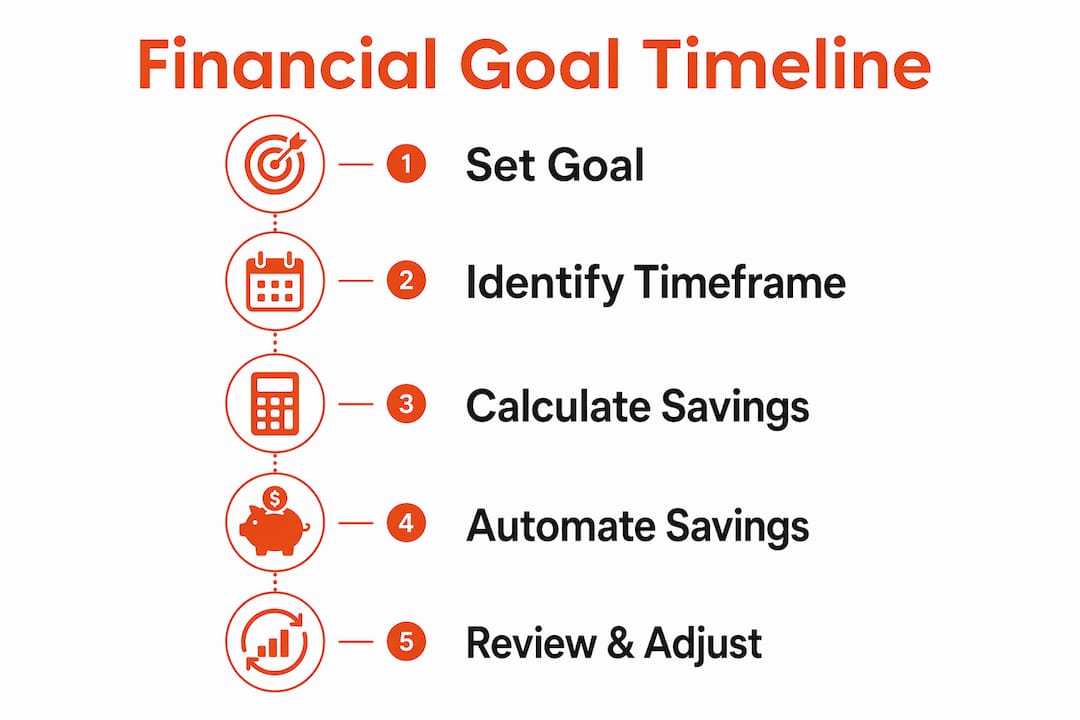
Here is a step-by-step process to build your timeline:
-
Name the goal specifically. Write “save $8,000 for a home down payment” rather than “save money.”
-
Set a target date. Choose a realistic deadline based on your income and existing obligations.
-
Calculate the monthly savings requirement. Divide total cost by months remaining.
-
Check it against your budget. Confirm the monthly amount fits within your income after essentials.
-
Open a dedicated account. Separate savings accounts for each goal prevent accidental spending.
-
Automate the transfer. Schedule the contribution on payday so it moves before you can spend it.
Pro Tip: Automate your savings transfer for the day after your paycheck lands. Behavioral finance research consistently shows that people who automate savings contribute more consistently than those who transfer manually.
Why prioritizing and adjusting your financial goal timeline matters
Most people carry more than one financial goal at the same time. A couple might be saving for a vacation, paying down credit card debt, and building an emergency fund simultaneously. These goals compete for the same limited monthly cash flow, and trying to fund all of them equally often means none of them get funded adequately.
The right priority order is not arbitrary. Emergency funds and high-interest debt repayment come first because they protect you from financial setbacks that would derail every other goal. Once those foundations are in place, you can direct cash flow toward medium-term and long-term goals without the risk of a single unexpected expense wiping out your progress.
Life changes, and your timeline should change with it. A job loss, a new baby, or a medical expense can all disrupt your savings rate. Certified financial planners recommend adjusting timelines or contribution amounts rather than abandoning goals entirely when circumstances shift. Extending a timeline by six months is far better than giving up and starting over.
Common pitfalls to avoid:
-
Setting too many goals at once without ranking them by urgency
-
Treating a missed month as a reason to quit rather than a reason to recalibrate
-
Ignoring inflation when setting long-term savings targets
-
Skipping annual reviews after major life events like a marriage, job change, or home purchase
Pro Tip: Schedule a 30-minute “money date” with yourself or your partner every january to review all active timelines. Annual reviews catch drift early before small gaps become large shortfalls.
How does a financial goal timeline prevent reactive spending?
A financial goal timeline gives every dollar a job before you spend it. That single shift in mindset is what separates people who consistently build wealth from those who earn well but save little.
When your money is categorized into goal-bound pools, you stop treating your account balance as permission to spend. The timeline creates a psychological boundary: this $300 is for the vacation fund, that $500 is for the down payment. Impulsive purchases compete against named goals, not against an abstract number. That competition changes the decision.
Timelines structure fund allocation to prevent reactive debt cycles. Without that structure, a surprise expense often lands on a credit card because there is no designated savings pool to draw from. With a timeline in place, you build the emergency fund first precisely to absorb those surprises without going into debt.
The benefits of time-bound financial goals extend beyond saving. They reduce financial anxiety because you always know where you stand. You are not guessing whether you can afford something. You are checking a number against a plan.
Key Takeaways
A financial goal timeline is the single most effective tool for turning income into lasting wealth because it connects every dollar to a deadline and a purpose.
| Point | Details |
|---|---|
| Define your time horizon first | Short, medium, and long-term goals each require different savings vehicles and risk levels. |
| Use SMART math to set monthly targets | Divide total goal cost by months remaining to get a concrete, testable savings number. |
| Apply the 60/30/10 rule as a baseline | Allocate 60% to essentials, 30% to discretionary, and 10% to savings to keep goals funded. |
| Prioritize emergency funds and debt first | Essential goals protect your plan from setbacks before you fund discretionary goals. |
| Review and adjust, never abandon | Extending a timeline beats quitting; annual reviews keep savings rates realistic. |
Why I think most people set timelines wrong
Most financial advice tells you to write down your goals and attach a date. That part is fine. What it misses is the order of operations. People build timelines for the exciting goals first: the vacation, the home, the early retirement. They fund those goals while carrying high-interest debt and no emergency fund. Then one unexpected car repair blows up the whole plan.
The timelines that actually work start from the bottom up. You build the floor first: three months of expenses in a liquid account, high-interest debt cleared, then you layer the aspirational goals on top. That sequence feels slower at the start. It is not. It is the only sequence that does not collapse under normal life pressure.
The other mistake I see constantly is treating a timeline as a contract rather than a living document. Rigid timelines fail because life is not rigid. The couples and individuals who reach their goals are the ones who review their timelines regularly and adjust without guilt. Missing a month is data, not failure. Use it to recalibrate the deadline or the monthly amount, then keep going.
Visualizing the timeline also matters more than most people expect. A simple spreadsheet or even a handwritten chart showing your progress toward each goal creates accountability that a mental note never does. You see the gap closing month by month. That visibility is motivating in a way that abstract intentions are not.
— Srini / Founder @ DivvyUpp
Divvyupp makes your financial timeline visible every day
Setting a timeline is the plan. Sticking to it through daily spending is where most plans break down. Divvyupp gives you a single “safe-to-spend” number each day, calculated against your real spending rate and the days left in your billing cycle. You always know whether a purchase fits your plan before you make it, not after the statement arrives.

Divvyupp is built for people with real goals: saving more, paying down debt, or reaching financial independence. It is also built for couples who want a transparent, fair way to manage shared budgets without conflict. Your money stays in your own bank. Divvyupp just tells you what is safe to spend today so your monthly savings targets stay intact. Try Divvyupp free, no signup required.
FAQ
What is a financial goal timeline?
A financial goal timeline is a structured schedule that links a specific savings target to a deadline, then calculates the monthly contribution needed to reach it. It organizes goals by time horizon: short-term (under 1 year), medium-term (1–5 years), and long-term (5+ years).
How do I calculate my monthly savings target?
Divide your total goal amount by the number of months until your deadline. A $24,000 goal over 48 months requires $500 per month, as the SMART framework recommends for measurable, time-bound planning.
What budgeting rule works best for financial goal timelines?
The 60/30/10 rule allocates 60% of take-home pay to essentials, 30% to discretionary spending, and 10% to savings. It provides a sustainable baseline that funds near-term goals without eliminating current lifestyle spending.
How often should I review my financial goal timeline?
Review your timeline at least once per year or after any major life event such as a job change, marriage, or large unexpected expense. Annual reviews catch contribution gaps before they become serious shortfalls.
What should I prioritize when I have multiple financial goals?
Fund your emergency fund and pay off high-interest debt before directing money toward discretionary goals. These foundations protect every other goal from being derailed by a single unexpected expense.