
TL;DR:
- Using purpose-named jars and scheduled automation helps stop overspending before it happens. DivvyUpp provides real-time safe-to-spend signals, confirming affordability at each purchase decision.
Use purpose-named jars plus scheduled automation, then check your real-time safe-to-spend before every discretionary purchase. That combination stops overspending before it happens, not after the statement lands.
Here's the fastest way to start today:
- Pick three jars: one for an emergency fund, one for a near-term goal (vacation, car repair), one for guilt-free spending.
- Set automatic transfers to fund each jar the day after your paycheck clears.
- Before any unplanned purchase, check DivvyUpp's daily safe-to-spend signal to confirm you can actually afford it.
The reason this works immediately: naming a jar forces every dollar into a job. Unallocated money gets spent. Named money doesn't.
Table of Contents
- What is the jar savings system, and why does it change behavior?
- Who actually benefits from jar savings, and when should you skip it?
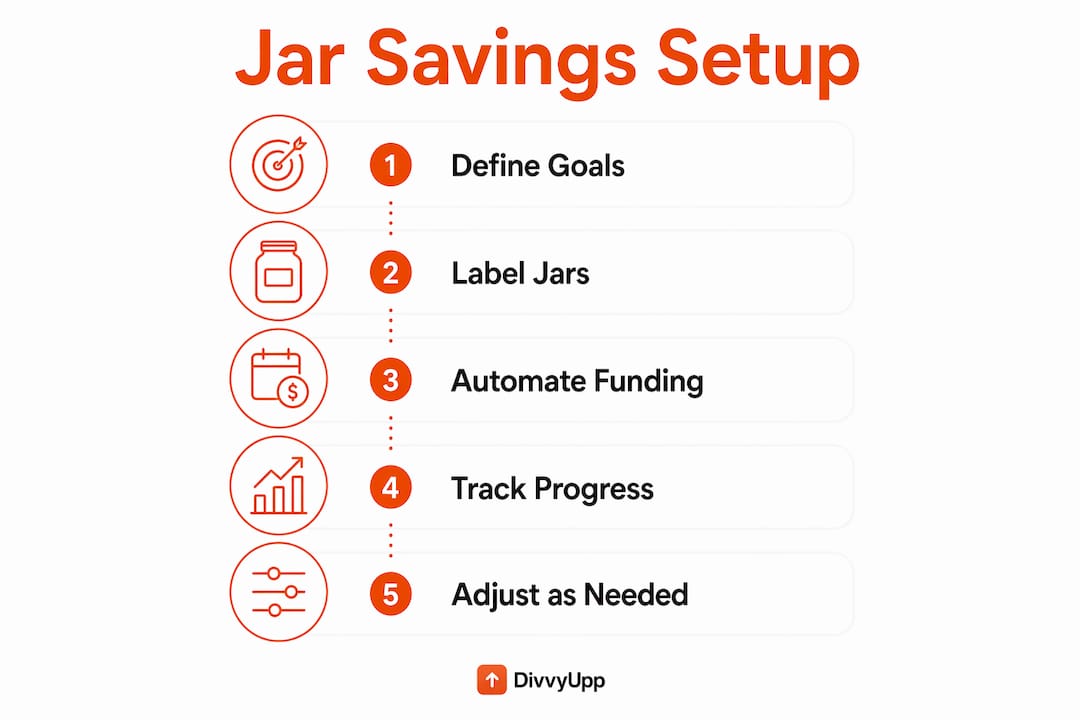
- How to set up jar savings in one week
- Physical jars, digital sub-accounts, or both?
- Common jar savings problems and exactly how to fix them
- How do you measure jar savings progress?
- Why DivvyUpp fits the jar method better than a spreadsheet
- Key Takeaways
- The part most budgeting advice skips
- DivvyUpp: a real-time layer for your jar system
- FAQ
What is the jar savings system, and why does it change behavior?
The jar savings system, sometimes called the jam-jar method, divides your income into labeled containers, each with a single purpose. Historically, workers received weekly cash wages and physically sorted bills into jars or envelopes for rent, food, and utilities. The digital version replaces glass with bank sub-accounts or savings "pots," but the psychology is identical.
Three behavioral mechanisms drive the results:
- Assignment of purpose. Every dollar has a named job, which reduces the diffuse spending that drains high earners who have plenty of income but no clear allocation.
- Visual accountability. Watching a jar fill toward a milestone is more motivating than watching an anonymous account balance tick up. The progress is visible and personal.
- Friction for discretionary spending. When the "fun money" jar is empty, you feel it. That pause before raiding another jar is exactly the moment impulse spending gets stopped.
A well-known incremental pattern is the Fidelity 52-week challenge, where you increase your weekly contribution by $1 each week and end the year with $1,378 saved. It works because automation converts the habit into a non-optional bill rather than a willpower exercise.
Pro Tip: Keep active jars to five or six at most. More than that and you're making too many micro-decisions each month, which drains decision-making capacity and kills follow-through. Group similar goals, like all "fun" spending, into one jar.
Who actually benefits from jar savings, and when should you skip it?
Jar saving fits some situations well and others poorly. Knowing which side you're on saves you a month of frustration.
Ideal for:
- High earners ($100K–$200K) who feel cash-poor despite strong income and need visible allocation to control discretionary drift.
- People with clear medium-term goals (vacation in eight months, new laptop, emergency fund target) who need visual progress to stay motivated.
- Anyone who has tried broad budgeting categories and found them too abstract to act on.
Less useful when:
- Your income is highly irregular and you can't predict a base amount to automate. In that case, a percentage-based system with a single "hold" account works better until income stabilizes. Self-employed readers tracking irregular cash flow may find structured bookkeeping a useful complement before layering in jar allocations.
- You're building a large emergency reserve or a down payment. Those belong in a high-yield savings account where they earn interest, not in a labeled pot that sits flat.
- You have more than six financial priorities competing at once. Jar saving scales by adjusting jar size and cadence to income stability, but it doesn't solve priority overload.
How to set up jar savings in one week
This plan works for a reader bringing home roughly $8,000 a month after tax. Scale the dollar amounts up or down; the structure stays the same.
Day 1: Choose your goals and pick three to five jars
- List every financial goal you have right now.
- Rank them by urgency and circle the top five.
- Name each jar after its goal, not a category. "Maui trip" beats "vacation."
Day 2: Assign target amounts
- Emergency fund jar: $500–$1,000 initial target, then $200/month until you reach three months of expenses.
- Near-term goal jar (vacation, car repair): $300–$500/month depending on timeline.
- Discretionary jar (dining, entertainment): $400–$600/month, hard stop when empty.
- Debt paydown jar (if applicable): $300–$500/month minimum.
- Investment jar: whatever remains after the above, minimum $200.
Day 3: Open sub-accounts and set standing transfers
- Open a separate savings account (or savings pot within your existing bank) for each jar.
- Schedule automatic transfers for the day after each paycheck. Treat them like a bill: pay yourself first, then spend what's left.
Day 4–5: Set spend rules
- Write one rule per jar: "Discretionary jar only for dining and entertainment. When it's empty, I wait."
- Add DivvyUpp to your phone and connect your bank account via Plaid. Check the daily safe-to-spend number before any unplanned purchase.
Day 6–7: Run a dry test
- Track every purchase against the correct jar for two days without changing behavior.
- Note which jar runs short fastest. That's your underfunding signal.
For a daily spending limit that keeps jar allocations intact, the key is scheduling transfers before discretionary access, not after.
Physical jars, digital sub-accounts, or both?
| Criterion | Physical jar | Digital sub-account | Hybrid |
|---|---|---|---|
| Visibility | High (tactile, immediate) | Medium (requires app check) | High |
| Automation | None | Full (standing transfers) | Full |
| Security | Low (cash at home) | High (FDIC-insured) | High |
| Friction to spend | High (deliberate withdrawal) | Low (easy transfer) | Medium |
| Interest earned | None | Possible (HYSA) | Possible |
| Best for | Short-term, visual motivation | Multi-month goals, safety | Most readers |

Physical jars work best for goals you'll hit in weeks to a few months, where the tactile feedback keeps you going. Digital sub-accounts are the right call for anything over three months, especially emergency funds, because the money is insured and can earn interest. The hybrid approach pairs a physical jar for near-term motivation with digital pots for longer-term safety, and most readers find it the most sustainable setup.
Pro Tip: If your bank offers named savings pots with instant transfers, use those as your digital jars. Separate pots with standing orders are the closest digital equivalent to the original cash-in-a-jar system.
Common jar savings problems and exactly how to fix them
Too many jars. Red flag: you can't remember what each jar is for without checking. Fix: collapse to five or fewer. Experts recommend keeping active jars under five or six to avoid decision fatigue.
Underfunded jars. Red flag: the same jar runs dry every month by week two. Fix: raise the contribution or lower the goal timeline. Don't borrow from another jar; that defeats the system.
Vague goals. Red flag: a jar labeled "savings" with no target amount or date. Fix: every jar needs a dollar target and a deadline. "Emergency fund: $6,000 by December" is a goal. "Savings" is not.
Letting full jars sit idle. Once a jar hits its target, pre-plan the next move before it fills. Reallocate to a new goal, move to an investment account, or redirect to an existing jar. Inertia after a win is where momentum dies.
Raiding jars. Fix: add one step of friction. For digital jars, require a 24-hour waiting period before any unplanned transfer out. For physical jars, use a coin-slot lid. The spender vs. saver dynamic is real, and friction is the practical countermeasure.
Pro Tip: Design the "next move" for each jar before it fills. Write it on a sticky note attached to the jar or in the account nickname. A jar with a pre-planned next step stays active; one without a plan just collects dust.
How do you measure jar savings progress?
Four metrics worth tracking each pay period:
- Percent-to-goal: current balance divided by target amount. Aim for a straight line upward.
- Contribution rate: dollars added per pay period. If this drops two cycles in a row, something is wrong.
- Months-to-target: target amount minus current balance, divided by monthly contribution. Recalculate monthly.
- Days of discretionary cash left: how many days your discretionary jar can cover at your current spending rate. DivvyUpp surfaces this as a daily safe-to-spend signal, updated in real time.
Visual accountability matters more than most people expect. Drawing a milestone line on a physical jar, or watching a digital progress bar cross 50%, produces a measurable motivational lift that an anonymous account balance simply doesn't. Pair that visual cue with automation and the behavior change tends to stick.
Most readers notice a real shift in spending habits within 30–90 days. The first month is mechanical: you're just following the rules. By month two, the named jars start to feel like real commitments. By month three, checking the safe-to-spend before a purchase becomes automatic. Track your financial goal timeline to keep milestones visible and motivation intact.
Why DivvyUpp fits the jar method better than a spreadsheet
Three tool categories support a digital jar setup:
- Bank savings pots: built-in sub-accounts with named goals and standing transfers. Good for the jar structure itself.
- Automated transfers: scheduled standing orders that fund jars on payday. Non-negotiable for consistency.
- Real-time safe-to-spend apps: the layer most jar systems miss. Knowing your jar balances is useful; knowing whether you can afford today's purchase without breaking a jar is what actually stops overspending.
DivvyUpp fills that third role. It connects to your bank via Plaid, analyzes your actual spending rate against the days left in your cycle, and gives you a single daily number: safe, risky, or yes-but-here's-the-cost. Your money never leaves your bank. DivvyUpp doesn't move funds or store card numbers. It just answers the question you're actually asking at the point of purchase.
Setup takes about ten minutes:
- Connect your bank account via Plaid.
- Set your monthly savings targets (one per jar goal).
- Check the daily safe-to-spend number each morning or before any unplanned purchase.
- Turn on SMS alerts for low-balance warnings so you catch underfunded jars before they cause a problem.
High-earner readers working with lifestyle-level financial goals find the combination of named jars and a real-time affordance signal particularly effective because it closes the gap between intention and action at the exact moment a purchase decision happens.
Key Takeaways
The jar savings system works because named allocations plus real-time safe-to-spend signals stop overspending at the moment of decision, not after the statement arrives.
| Point | Details |
|---|---|
| Name every jar | A jar labeled with a specific goal ("Maui trip") outperforms a generic category every time. |
| Automate on payday | Schedule transfers the day after your paycheck so savings are funded before discretionary spending begins. |
| Cap active jars at five or six | More than five or six jars creates decision fatigue and reduces follow-through. |
| Track four metrics | Monitor percent-to-goal, contribution rate, months-to-target, and days of discretionary cash left each pay period. |
| Use DivvyUpp for real-time signals | Check the daily safe-to-spend number before any unplanned purchase to keep jar allocations intact. |
The part most budgeting advice skips
Most jar-savings guides stop at the allocation step, as if naming a jar is the hard part. It isn't. The hard part is the moment you're standing in a store or about to click "buy" and you genuinely don't know whether you can afford it without breaking a jar you care about.
That gap between "I have a plan" and "I know right now if this purchase fits the plan" is where high earners lose the month. Not to recklessness. To uncertainty. When you're not sure, you spend. When you know, you decide.
The jar system handles the structure. A real-time safe-to-spend signal handles the moment. Neither works as well without the other, and most budgeting tools only give you one.
The behavioral research on assignment of purpose is solid: named allocations reduce diffuse spending. But the research on decision points is equally clear. Friction and real-time feedback at the moment of purchase are what convert a plan into a habit. A jar you funded last Tuesday doesn't tell you whether today's $80 dinner is safe. A live number does.
Build the jars. Automate the funding. Then get a tool that answers the actual question.
DivvyUpp: a real-time layer for your jar system
If you've set up your jars and automated your transfers, you've done the structural work. What most people still lack is a live answer to "can I spend this right now without wrecking my plan?"
DivvyUpp gives you that answer. It's a non-custodial app that connects to your bank via Plaid, calculates your daily, weekly, and monthly safe-to-spend based on your real spending rate, and tells you whether a purchase is safe, risky, or yes-but-here's-the-cost. Your money stays in your own bank account. DivvyUpp never moves funds or stores card numbers.
It's free to try during the beta period, with a paid subscription for full-feature access. No long setup, no financial plan to build first. Start at divvyupp.com and check your first safe-to-spend number today.
General information, not financial advice. Confirm your own situation with a qualified financial professional.
FAQ
What is the jar savings system?
The jar savings system divides your income into labeled containers, each assigned to a single goal, so every dollar has a named purpose before you spend. It works with physical jars, bank sub-accounts, or a combination of both.
How many jars should you have?
Keep active jars to five or six at most. Experts recommend this limit to avoid decision fatigue, which reduces follow-through when you have too many competing allocations.
How do you fund jars automatically?
Set a standing transfer to move money into each jar the day after your paycheck clears. Treating savings like a bill, paid first before discretionary spending, is the most reliable way to keep jars funded consistently.
How does DivvyUpp support the jar method?
DivvyUpp adds a real-time safe-to-spend signal that tells you whether a purchase is affordable today without breaking your jar allocations. It connects to your bank via Plaid, never moves your money, and updates your daily number based on actual spending rate versus days left in your cycle.
How long before you see results from jar saving?
Most people notice a real shift in spending behavior within 30–90 days. The first month is mechanical habit-building; by month three, checking your safe-to-spend before a purchase typically becomes automatic.